Saturday, October 19, 2013

Muxia, a beautiful port in the storm

We ended our Camino in the beautiful seaside town of Muxia (pronounced Mooshia) approx 28 km from Finesterre.  The towns are very similar -- both built on a peninsula at the end of the world, graced with long sandy beaches, and fierce rocks, white with crashing waves.  Many ships have gone down in their treacherous waters and both have long breakwater/jetties to protect their fishing fleets.  Both towns were destroyed by Napoleon's troops in the early 19th century and rebuilt, so have a fairly fresh feel.

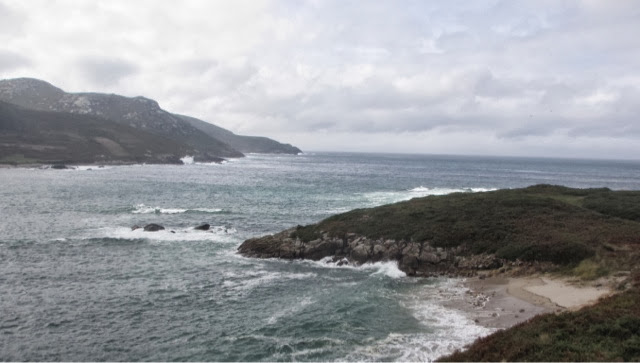
We liked Muxia best, just seemed more colorful and had a nice feel.  Here are some pix, first as we arrived, walking along the edge of the pavement of the highway into town, a very pretty beach:

Fortunately, we came to a sidewalk, but there seemed to be something very strange about it,  when we got closer, we discovered the locals had covered the sidewalk with some sort of seaweed they were letting dry.  Reminded me of the dulse we used to eat in Nova Scotia.  Didn't taste any to confirm!

And into the town itself, a great place for wave watching:

The far end of this concrete pier seemed to be the gathering place for children and families, with a fenced playground safely away from the crashing waves:

In the morning, after a night of heavy rain, we took advantage of a break in the storm to climb the rocky peak at the edge of town, with great views looking back and out into the waves.  I don't recall ever being in winds so strong -- hard to convey in a pic, but you can see Jan's clothes all billowy -- fortunately a tailwind:

From the top, with the crashing waves on the right, the sheltered harbour on the left and the entire town squeezed in between.  A stone cross in the left foreground.  I fell right beside it, due to the crazy wind, and clonked my elbow on the rock:

Then the heavy rains resumed and we found some shelter in the doorway of a church built at the water's edge and did some storm watching.  Very impressive:

We stood there, just barely out of the storm, until the winds shifted and we had to leave.    During the walk back to down we got royally drenched -- it was an absolute cloudburst.  We had left our packs at the albergue, and inside them our rain pants, but our shoes and socks were the biggest causality -- completely soaked.  I wondered if the town (Mooshia) got its name from the sound made of people plodding along in soaking wet shoes.

When we got back to town, we came across a few locals sitting on benches under an overhang, so we grabbed a bench just around the corner from them and  caught our breaths.  Turned out this place was the police station, but no one seemed to mind us sitting there:

After slightly drying off, we mooshed over to a local cafe for a cafe con leche and we felt human again. By now, the albergue (Bela-Muxia) would have reopened and we could claim our packs, but it was still 2 or 3 hours till our bus would leave for Santiago.  We asked the hospitalero at the albergue if we could sit and wait for our bus there -- "No problem!".  He had also suggested to us that we leave our packs there before we went out, so I wasn't surprised.  We sat in the kitchen with a few other drowned pilgrim rats and ate some lunch (boiled eggs from dinner, with mayo on a baguette) while the storm raged outside.  He was such a nice man -- hugged Jan, and gave me a warm two-handed handshake, as we left.

The storm finally broke just before the bus left.  Our boots were too wet to wear, so we put them in our packs and wore our sandals - much more comfortable.

Riding in the bus after six weeks or so of only traveling by foot was a bit surreal and sad at the same time.  But when the clouds burst again after a short while on board, we were thankful to be inside, in a comfortable seat on a bus back to Santiago.  We'd stay two more nights at the Lasalle Albergue/Hotel in Santiago (same place we stayed at week earlier), then on Sunday take the train to Madrid, where we'd spend three nights, then fly home, sweet home.

We'll be spending the time reflecting on our journey, lessons learned etc and likely do a few more posts to tie things up.

Friday, October 18, 2013

Our last day of walking -- to Muxia, another end of the world (Th 17 Oct)


We left Fisterre and headed towards Muxia (pronounced Mooshia).  It was a fine day, unusual for this time and place and we were enjoying the walk.  We had not yet decided on our plans for the next few days, till we fly home from Madrid next Wed 23 Oct.  Partway through the walk, we decided Muxia would be a good place to end our journey.  There's no further to go -- all we can do is head back to Santiago.  We decided to take the bus back to Santiago, then on to Madrid where we'll spend a few days before catching our plane.  It was a simple enough decision to make, but the impact on us was powerful.  This would be our last day of walking on our Camino journey, and we felt a bit sad.  Our last chance to hear the roosters crow and cows moo, our last day to enjoy birdsong, enjoy seeing dogs snoozing in the sun, horses and donkeys grazing in beautiful fields of green.  Our last time to stroll through the farming hamlets, with the earthy odour of cow barns, the interesting mix of decaying stone buildings and fences alongside freshly painted homes, watching the local folk go about their days, busy with harvest this time of year.

Pausing for a coffee in a local bar.  Pulling into an albergue, finding some dinner.  Last time for all this ... until our next Camino.  The Camino is now part of who we are and we are part of what and who the Camino is. It has worked its magic on us and we are so glad to have had the time and health and energy to be part of this wonderful experience.  

Buen, Buen Camino.

The old next to the new:

Horses (with their manes coloured by the hay):

and donkeys:


and little lambs (we never did see them eat ivy):


And the views, of farmlands and mountains...

And sea:


And then back into the pine and eucalyptus forests:

with a bed of rust-coloured ferns preparing the forest for winter:

And markers of concrete and simple handwritten signs -- a pilgrim's best friends:

And people.  Today, at the bottom of a valley with a steep road leading up each side, an elderly woman paused to chat with us, saying much more than we could understand, but with a smile so we understood her intention.  After we'd exchanged farewells, we turned to see if she'd be heading up the hill and she was.  People here have strong legs and lungs.

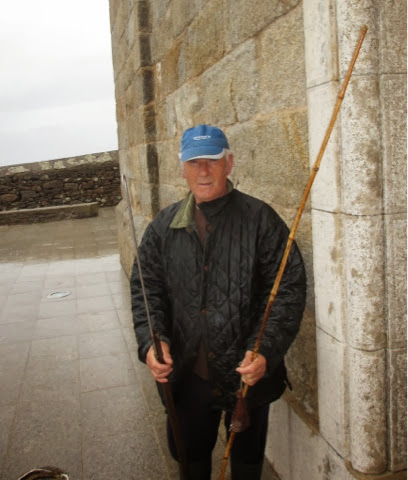
And a man stopped to chat, telling us he was going to get some Pulpo (octopus) and showed us his hunting/fishing tools and how he'd catch them.    He dangles the bait (in the small bag on a string in his left hand) near the Pulpo to entice it out of its normal hiding place in the rocks, and uses the long stick in his left hand to prod it some more and lands it with the stick with the metal hook in his right hand:

The other interesting aspect of today's walk is that we met many pilgrims walking from Muxia to Fisterre.  Both are roughly at the end of the world and people go to either one first, then walk to the other.  This stretch is the only place on the Camino with significant traffic in both directions.  For most of the Camino's history, pilgrims walked both ways, so we got to experience how it must have been -- people asking each other what's ahead, where's a good place to eat or stay, etc

Nice to get a glimpse into how things were.

A great walk to end our long walk.  Muxia is a very pretty town and we'll post some pics on that tomorrowish.